by DALC Staff | Apr 22, 2025 | Connect with Nature, Driftless Trail, Preserves
 Shinrin-yoku, the practice translated as Forest Bathing, is an activity that invites us to slow down and really connect with nature, the experience that connects us all. It became popular in Japan in the 1980’s during the technology boom. With people working in buildings and cities, the Japanese noticed that people were not healthy and becoming sicker. They started creating places in nature and paid for workers to go out and reconnect with nature. There is plenty of research now that shows that being in nature helps regulate our mind and body connection, boosting our immune systems, and is an integral part of lifestyle medicine.
“Humans instinctively know that when we’re in nature, and we can slow down enough to use our sensory systems, we feel healthier and happier,” Martha says.
Forest bathing is not hiking but the intentional act of slowing down in nature. It starts with the breath, closing your eyes, listening to the sounds around you, acknowledging those who have been on the land before you, and honoring the wildlife, plants, and organisms that call the forest home.
It invites you to notice the smaller natural details like the fungus calling a decaying log home and other parts of the natural world often passed over without a second thought. Walking through the forest like a camera and taking “snapshots” with your eyes to refocus your sight. Continuing, one could consider opening to a possible “treasure” just for you:. Being present and allowing what that word “treasure” means to you on your journey through the forest.
“For me, as I age and move into Elder work, it’s nature and the interwoven experience of being in the awesomeness of this relationship. What is our relationship with the natural world? How can we be kinder, more generous, and have a creative connection? How can we translate that into human connection as well as care for the Land?” Martha shares. “It’s sort of like breathing or eating. The need to return to the chemistry and energy of the forest and the trees. We miss so much when we are hiking and talking. Forest bathing invites us to be present and momentarily step away from the busyness of our lives. It allows us to open our hearts and minds which is truly healing.”
As DALC celebrates Earth Month and the incredible work our community is doing to protect the land, we invite you to explore some of these practices and enjoy an intentional connection at any of our nature preserves or Driftless Trail segments.
You don’t need to go with a guide to experience the benefits of forest bathing, however, if you are interested in connecting with Martha you can learn more at marthayork12@gmail.com.
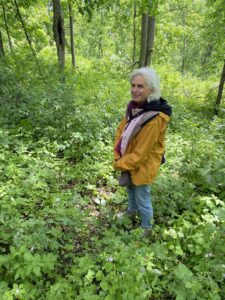
Martha York, DALC supporter, trained in the lineage of Shinrin-yoku, a form of Japanese Forest Therapy.

by DALC Staff | Aug 29, 2024 | Conservation, Land Protection, Preserves
In early August, 2024 we welcomed a brand-new Nature Preserve: Dragon Woods! This beautiful oak woodland in New Glarus is a cooperative project of DALC and the BadgerLand Foundation, which jointly co-manage the nearby Wild Oaks Preserve. We are grateful to the Knowles-Nelson Stewardship Program and Dane County’s Conservation Fund Grant Program for making this purchase possible. Find more details about Dragon Woods in the sidebar below, and read on for former landowner Alice Berlow’s reflections on this magical place.
About Dragon Woods
- Location: Near New Glarus, off of County Road U, is less than half a mile away from Wild Oaks Preserve.
- Size: 31 acres
- Land acknowledgement: According to Native Land Digital, Dragon Woods and the surrounding land was historically inhabited by the indigenous people of the Fox, Ho-Chunk, Sauk, Kickapoo, and more.
- Highlights: This lovely oak woodland has a resilient understory of native plants with limited invasive brush – historically common in the Driftless, but a rarity today! This ecosystem supports a wide diversity of birds and insects. In an area with increasing development pressure from nearby cities and towns, Dragon Woods adds another piece to a matrix of protected land, creating a vital corridor of sustainably managed habitat and green space.
- Visitor guidelines: This is a very recent acquisition, and we are working on signage, trails, and access considerations. Please keep an eye on DALC’s website, social media, and e-news for updates. If you are interested in hearing about volunteer opportunities, please contact Fil Sanna at filsanna@yahoo.com.
Here are three things to know about Dragon Woods:
- For eons, countless sentient beings, including animals and people I love, have walked these lands. And now, countless more, like you, will be able to enjoy Dragon Woods because Driftless Area Land Conservancy (DALC) is stewarding this land according to the organization’s three pillars: conserve, care, and connect.
- Every time you tread lightly here, you will never walk the same path twice. Every being you walk with, will always experience the land in their own unique ways. Let them.
- A dragon lives here, there’s no need to fear them. This dragon is generous, compassionate, adventurous, benevolent and is as curious about you, as you are about them. If you catch a glimmer of even their shadow, consider yourself lucky. Hold that gift close and share it with someone who’ll cherish it too.
And now here are somethings to know about me:
Selling these acres into permanent conservation was my only option because active, responsible land stewardship aligns with my core values.
The land ethic I live by was instilled and informed by my parents (Paul and Emy Gartzke, may their memories be a blessing). It’s one that is based in love for the beauty of this part of Wisconsin and being able to share it inclusively with the community. Holding onto these acres as a private owner had begun to feel selfish, entitled, and short-sighted. But now, with DALC’s permanent public access, many more people can enjoy the land, and I can always return to visit and appreciate the gift that was given to me and the gift it is now for you.
For me, conserving green spaces today in the Driftless is critical because of the rapid and encroaching building development of Madison, Fitchburg, and Verona. I grew up in the area and have seen how fast farmlands, waterways, and wooded lots are being turned into developments and large-scale industrial agricultural operations.
It’s important to me that people of all ages have access to green spaces in order to have the kinds of outdoor opportunities and experiences that I had. It’s here in Dragon Woods where my younger self wandered in exploration, physical activity, wonder, awe, curiosity, and connection.
That’s still what the outdoors does for me. These are places where I can get lost, turn off my phone, take deep breaths, dream, think clearly, amble shod or barefoot over the roots, through the grasses and on snowy trails. To feel how the air smells and listen to how light plays on any given day, in any given season over time.
Even though forever conservation was the clear path for me in this land transaction, it wasn’t always easy. But with time and grace, ease and excitement grew. DALC, with its stellar professional reputation and network, secured funds to help support the purchase of Dragon Woods. I’m very grateful to Wisconsin’s Knowles-Nelson Stewardship Program, the Department of Natural Resources, and Dane County for their contributions. And, of course, to the board and staff at DALC, the BadgerLand Foundation, and all their collective supporters and community members who made this transfer possible, fair, and secure.
But by far, I am most grateful to my parents, who purchased this land in the 1960s and, in doing so, ended up paying it forward, as these parcels have turned out to be pivotal in DALC’s effort to create a green necklace in this area. Dragon Woods, I think, is a name worthy of such a pendant in a necklace of conservation.
And the mythical dragon of Dragon Woods? The story begins when the dragon was memorialized as a sculpture. A likeness and a gift handed down to me from my mom; they have the right to live in these woods forever, though they’re rarely, if ever, seen.
This dragon has many things to say–wisdom and stories to share about the land. About glaciers, constellations, fire, rust, footsteps, sledding, and climbing trees. Owls in hollows, mushrooms, moss and thorns, snakes in the grass, bats in roost, deer trails, lone fox, and circling red-tailed hawks. And there will be many more stories to come in many more shapes, sizes, and languages, only and all because of you and for you. That’s the true legacy of Dragon Woods.
Written by Alice Berlow (née Gartzke)

by DALC Staff | Aug 3, 2024 | Conservation, Land Protection, Preserves
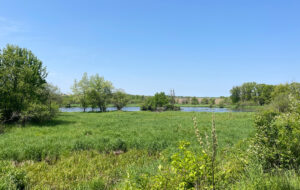
Sometimes it’s easy to imagine that the best parts of nature are far away, hidden on high mountaintops or secret valleys, only reachable after a trek and a scramble. But our favorite wild places are often right in our own backyards – and having nature so close to us makes it that much easier to take the initiative to head out and care for it. That’s exactly what DALC has seen with Erickson Conservation Area.
Nestled within the village of Argyle, bordered by the high school on one side and the Pecatonica River on the other, Erickon’s 220 acres of wetland, prairie, and oak savanna has long been a fixture in the community. Volunteer Neale Tollakson says his history with the land goes back over 60 years.
“I used to come out here when I was 8, 9, 10 years old, birdwatching,” Neale describes. “The wetland, the sloughs, the river were places to go duck hunting.”
Interested in local history from a young age, Neale would also search for Native American artifacts. Nearby archeological sites like burial mounds and rock shelters show millennia of human use in these parts. Historic Argyle, an organization that Neale is a part of, is working on an updated history of the region including glacial records and information on the indigenous people of the area – stay tuned!
Neale wasn’t alone in his adventures out at Erickson. Community members would cross-country ski in winter, picnic under the shade of oak trees in the summer, and hike out along the railroad bed – the train stopped running around the 1930s. A series of farmers had rented the property, but periodic flooding made for poor crops. Neale recalls beef cattle grazing there and corn being planted in dry years, but gradually the unproductive fields were abandoned.
Then the land was purchased by Alex and Mary Erickson. Alex was an enthusiastic conservationist who planted tamaracks, swamp white oaks, and perennial shrubs to provide food for wildlife. “Seeing this land protected so that it will inspire kids and the Argyle community has always been a dream of Alex’s,” Mary shared.
That dream was realized in 2012, when Alex and Mary sold the land that would become Erickson Conservation Area to DALC in a generous bargain sale. The funding balance was made up by a grant from the Knowles-Nelson Stewardship Program .
A significant reason DALC decided to take the plunge and own a nature preserve was due to the steadfast support of the local community. From the start, Erickson has had a dedicated crew of volunteers carrying out projects and welcoming the community to explore this Ambassador Property.
 Over the past twelve years, stewardship and access projects have ticked steadily along. An AmeriCorps crew built a boardwalk through the wetland. A kiosk was designed and installed. Trails were diligently mowed. A few areas that had still been in agriculture were planted into prairie, and prescribed fire returned to the landscape.
Today, with a strong foundation of stewardship in place, restoration is progressing rapidly.
Visitors might be surprised by some of the work. Intensive forestry clearing is planned across several units of the property, which will result in the removal of many native shrubs and stands of trees.
Opening up these areas will make for much more expansive vistas for hikers and skiers to admire. But that’s not the main reason for the work. “Visual line of sight goes beyond the visitor experience,” explains Zach Pacana, DALC’s Land Management Specialist. “If you’re a bird or an insect, you can’t necessarily see beyond a wall of trees,” so reducing density will allow animals to move more freely between areas of habitat. In addition, thinning shrubs and trees will create better conditions for prescribed fire, a vital tool for suppressing invasive species and encouraging native plants.
And behind the scenes, we’re ramping up even more.
“The changes that are happening are not always something you can see,” Neale notes. “There are changes in DALC – to obtain more funding, acquire more properties, hire more people, and get more work done.”
In 2012, Erickson was our first-ever Nature Preserve and one of the biggest, most challenging projects we had ever done. It was the start of something new – something that would never have been possible without the support of an incredible community. We’re so grateful for volunteers past and present (and future!) who care for this wonderful place, and make it possible for us to protect and steward more land across the Driftless.

by DALC Staff | Feb 23, 2021 | Preserves
At the end of 2020, we received a remarkable gift: 300+ acres of a diverse Driftless landscape north of New Glarus. Thanks to the vision, dedication, and generosity of the local community, this special place was forever saved from development. At the time, we called this property Spring Valley Tract. But that name was always meant to be a placeholder, a temporary title while we got to know the land better. Now, after several years of exploration, restoration, and conversation, we are excited to share a new and permanent name:
Wild Oaks Preserve.
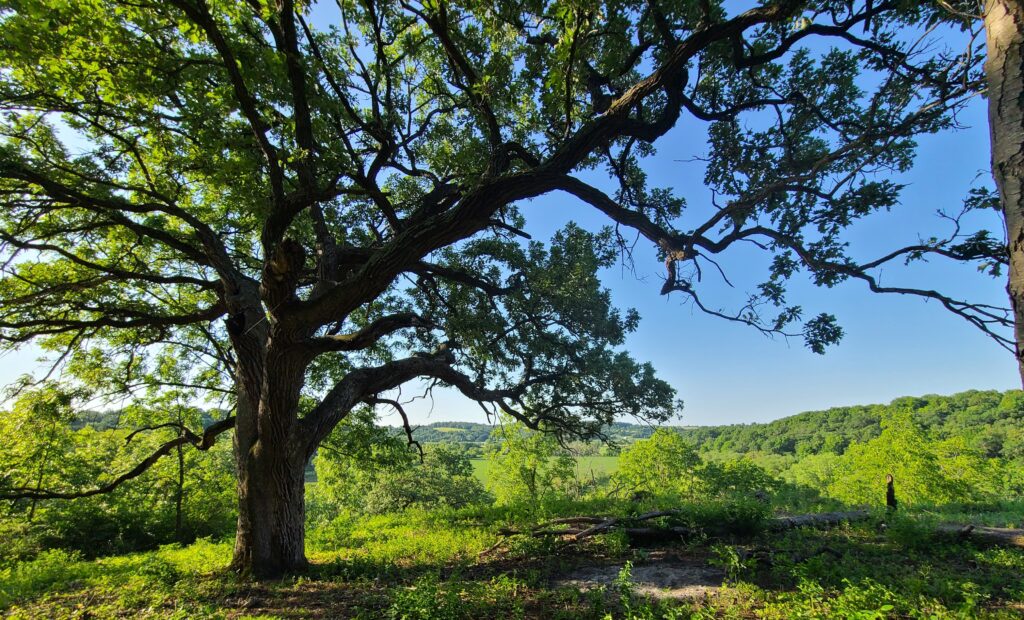
“Ryan’s Oak,” one of the most iconic trees at the preserve. Photo: Zach Pacana
This name was the result of careful thought and several rounds of community input. Below, site steward Fil Sanna shares some of the things this new name signifies for him.
This name is simple, and yet encapsulates several important aspects of the land and the project.
First, oak trees are a prominent symbol of the landscape. Even though the property is hugely diverse – containing oak woodland and savanna, native prairie, several types of wetlands, a spring-fed stream, pastures, and tilled cropland – almost anywhere you go, you are within sight of oaks.
Oaks are also a keystone species – one that helps define and hold together the entire ecosystem. Countless insects, birds, mammals, and smaller plants depend on oaks. Accordingly, we are working to preserve the oaks that are there and improve conditions for new oaks to sprout and survive.
As for the “Wild” part, the site was once wild and we are working to make it (relatively speaking) wild again. I’ve been fortunate enough to visit true wilderness in the mountains, and have pictured in my dreams how the vast tallgrass prairies of southern Wisconsin might have once looked. It’s my hope that we can rekindle enough of the latent wildness of the land to evoke something of what our ancestors saw when they came through these hills. In the words of Terry Tempest Williams: “Wildness reminds us what it means to be human, what we are connected to rather than what we are separate from.” Our hope is that future visitors will find inner rejuvenation and outward community in the wild corners of this place.
One final note: the site is historically and culturally rich. How do we properly honor those who came before us? We have been in conversation with officers and allies of the Ho-Chunk tribe, and our work nurturing these relationships will continue. We have researched the history of and had conversations with families who lived on the land in the past. There were at least three homesteads there. We are preserving the old barns at the historic Sonsteby farmstead and converting the farmyard into the main entrance for the property. The other two homesteads have ruins that can be featured along future hiking trails. And we expect that there will be other naming opportunities within the site – a council ring, different trails, a boardwalk, and more – to honor those who came before us as well as those deeply involved in the current project.
This is a big moment for the Wild Oaks Preserve – we’ve come a long way since we acquired this property less than three years ago!
Thank you to all who have given their time, energy, support, and creativity to Wild Oaks Preserve. We are still working on safe access to the site. If you want to visit Wild Oaks, contact us, or attend one of our many work days or events there! Find details on our Events Calendar.